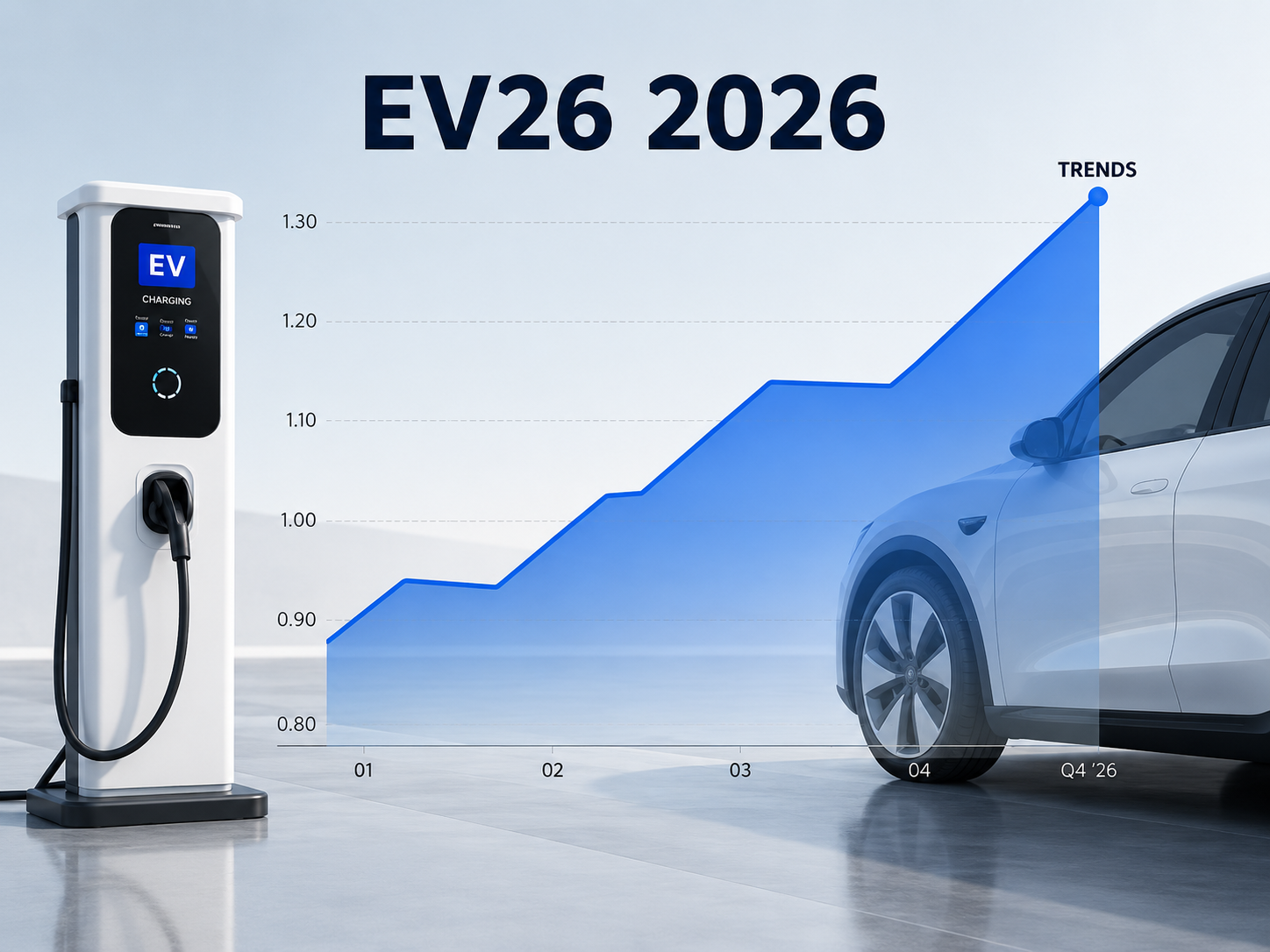
The EV conversation has matured. The question is no longer "will electric vehicles happen?", they're happening, but "what determines how fast, and who wins?" Increasingly the answer lies not in the vehicles themselves but in the two systems beneath them: the batteries that power them and the charging infrastructure that sustains them. Get those right and adoption accelerates; get them wrong and it stalls regardless of how good the cars are.
This piece examines the EV inflection point through the lens of batteries, materials, and charging, where the real growth, and the real bottlenecks, live.
The global EV battery market was worth roughly US$62–91 billion in 2024 and is forecast to more than double by the early 2030s (estimates vary by firm, Grand View Research, MarketsandMarkets, Polaris). Asia-Pacific holds over half of it, a signal that the decisive action has moved from the showroom to the supply chain and the grid.
The inflection has already happened
EV adoption has crossed the threshold from early-adopter curiosity to mainstream consideration in many markets. But mainstream adoption surfaces different challenges than early adoption did: mass-market buyers care intensely about cost, range, and charging convenience, exactly the dimensions governed by batteries and infrastructure. The inflection point isn't a single moment; it's the handoff from a phase driven by enthusiasm to one driven by economics and practicality.
Batteries are the real battleground
The battery is the most expensive, most strategically important component of an EV, and the locus of competition. Battery cost, energy density, charging speed, and longevity determine an EV's price, range, and appeal. That's why the EV battery market, estimated at roughly US$62–91 billion in 2024 and forecast to grow at a double-digit CAGR through the early 2030s (estimates differ widely across research firms), has become one of the most strategically watched sectors in clean energy, and why control of battery technology and supply is now a matter of corporate and national strategy alike.
Whoever controls the battery controls the EV. The competitive center of gravity in automotive has shifted from the engine to the cell.
EV competitiveness increasingly traces back to battery chemistry and cost. The automakers and suppliers winning aren't necessarily the best at building cars, they're the best at securing and advancing battery technology.
The materials bottleneck
Behind the battery sits an often-overlooked dependency: raw materials. Cathode, anode, and electrolyte materials, and the lithium, nickel, cobalt, and graphite feeding them, are the foundation of the whole EV edifice, and their supply is concentrated and price-volatile. The battery materials supply chain is becoming a strategic chokepoint, driving investment in localization, alternative chemistries, and recycling. The companies and countries securing materials access are buying leverage over the entire EV transition.
Material supply, not vehicle design, may be the EV transition's tightest constraint. Strategy that ignores the materials layer is building on a foundation it doesn't control.
Charging infrastructure as the gating factor
Even perfect batteries can't drive adoption without somewhere to charge. Charging infrastructure, availability, speed, reliability, and convenience, is the gating factor for mainstream buyers who lack the certainty early adopters tolerated. The strong projected growth of charging infrastructure reflects how decisive it has become: in many markets, the pace of charging build-out, not vehicle supply, now sets the ceiling on adoption.
What it means across the value chain
For everyone in the mobility value chain, the strategic map has shifted. Automakers are racing to secure battery technology and supply. Materials and chemicals players sit on an increasingly strategic chokepoint. Energy and infrastructure companies face a generational build-out opportunity in charging. And investors are repricing the whole chain around these realities. Navigating it requires granular, current intelligence on battery technology, materials supply, and infrastructure rollout, a landscape shifting too fast for static annual forecasts.
An India example
India's EV story is a useful reminder that the "inflection point" looks different in every market. Adoption there is led not by passenger cars but by electric two- and three-wheelers, where the economics already work for high-mileage users. That changes which bottlenecks matter: swappable batteries and battery-as-a-service models are more decisive than fast-charging highways, and government support for local cell manufacturing (via production-linked incentives) is aimed squarely at the materials-and-cells chokepoint. A global automaker that reads India through a Western passenger-car lens will misjudge both the demand curve and the infrastructure that gates it. The generalizable point: the battery-materials-charging framework holds everywhere, but which link binds tightest is a local, research-driven question.
Frequently asked questions
What's driving the EV inflection point?
The shift from early-adopter to mainstream adoption, where buyers prioritize cost, range, and charging convenience, dimensions governed by battery technology and charging infrastructure rather than the vehicles alone.
Why are batteries so central to EV competition?
The battery is the most expensive and strategically important EV component, determining price, range, and charging speed. The EV battery market, roughly US$62–91 billion in 2024 depending on the source, is forecast to grow at a double-digit CAGR through the early 2030s, reflecting that importance.
What is the materials bottleneck in EVs?
EV batteries depend on concentrated, price-volatile raw materials like lithium, nickel, and graphite. Securing this supply has become a strategic chokepoint driving localization, new chemistries, and recycling.
Why does charging infrastructure matter so much?
Mainstream buyers need convenient, reliable charging. In many markets the pace of charging build-out, not vehicle supply, now sets the ceiling on EV adoption, making infrastructure one of the fastest-growing parts of the value chain.
Why do EV market forecasts vary so much between reports?
Because firms define the market differently (cells vs. packs vs. materials), use different base years, and make different adoption assumptions. That's exactly why a strategy team should triangulate several sources and validate against on-the-ground reality rather than anchoring on a single headline number.
Future outlook
The EV transition will increasingly be won or lost in the supply chain and the grid rather than the showroom. As batteries improve and charging networks densify, adoption will accelerate, but unevenly, gated by materials access and infrastructure in each market. The players that thrive will be those reading the battery, materials, and charging landscape in real time and positioning ahead of the bottlenecks.
The question for every mobility player: are you competing on the cars, or on the batteries and chargers that will actually decide the race?
Key takeaways
- The EV inflection has shifted competition from vehicles to batteries and charging.
- Battery technology and cost are the central battleground (EV battery market ~US$62–91B in 2024, growing at a double-digit CAGR).
- Raw-material supply is a concentrated, strategic chokepoint.
- Charging infrastructure increasingly gates adoption, and which bottleneck binds is a local question.
Tracking the EV transition?
Zapulse provides real-time intelligence on battery technology, materials supply, and charging infrastructure, so mobility leaders position ahead of the bottlenecks.
Talk to our analystsRelated reading: The Materials Behind the Energy Transition · Automotive & Mobility reports
Sources
- Grand View Research, Electric Vehicle Battery Market (US$61.3B in 2024, 22.2% CAGR to 2030; APAC 51.8% share) www.grandviewresearch.com/industry-analysis/electric-vehicle-battery-market
- MarketsandMarkets, EV Battery Market (US$91.9B in 2024 to US$251.3B by 2035) www.marketsandmarkets.com/Market-Reports/electric-vehicle-battery-market-100188347.html
- Polaris Market Research, EV Battery Market (US$90.9B in 2024; APAC largest) www.polarismarketresearch.com/industry-analysis/electric-vehicle-battery-market
By Zapulse Research Team · Published Jun 15, 2026 · 8 min read · Automotive & Mobility